GEM Phase II Sampling Successfully Conducted in Shanghai’s Rivers and Estuaries
From 21 to 23 October 2026, the GEM Research Team conducted sediment and passive sampling across rivers and estuaries in Shanghai, China.
In accordance with the GEM Phase II guidelines, eight sampling sites were established across three estuarine systems: the Huangpu River Estuary, a Huangpu River tributary estuary, and the Dazhi River Estuary. The sampling design covered upstream and downstream river sections, as well as inner- and outer-estuary areas.
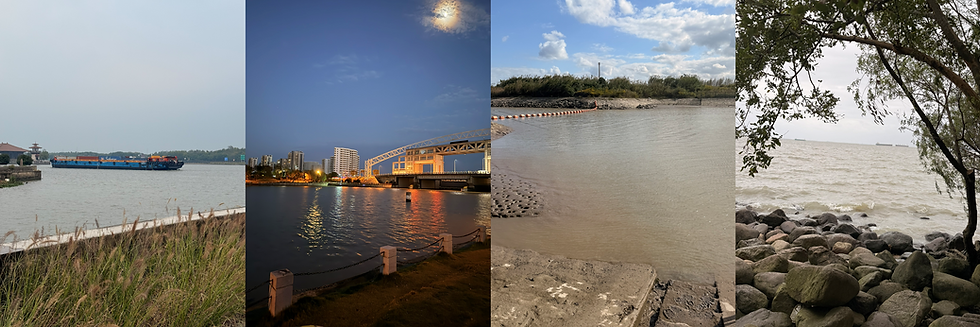
Sediment samples were collected for both emerging contaminant analysis and environmental DNA (eDNA) testing.
Passive samplers were successfully deployed at all sampling sites and will be retrieved after a 14-day deployment period. Three types of passive samplers were used: sponge samplers for emerging contaminants, IA-Z samplers for radionuclides and heavy metals, and semipermeable membrane devices (SPMDs) for efficiency comparison.
In addition, physicochemical water-quality parameters were measured at each site, and relevant environmental information was systematically documented.


This field campaign, jointly supported by the State Key Laboratory of Marine Environmental Health at City University of Hong Kong and the State Key Laboratory of Estuarine and Coastal Research at East China Normal University via its Open Research Fund, represents an important practical implementation of GEM Phase II.
We look forward to working closely with our global partners to support successful and harmonized sampling activities across all participating regions worldwide.